Know-How
Navigation: App Designer
The App Designer is a powerful tool of LOGIBLOX. It combines the full power of the data manager, Flow Builder and offers a new suite of App Templates for you to work with.
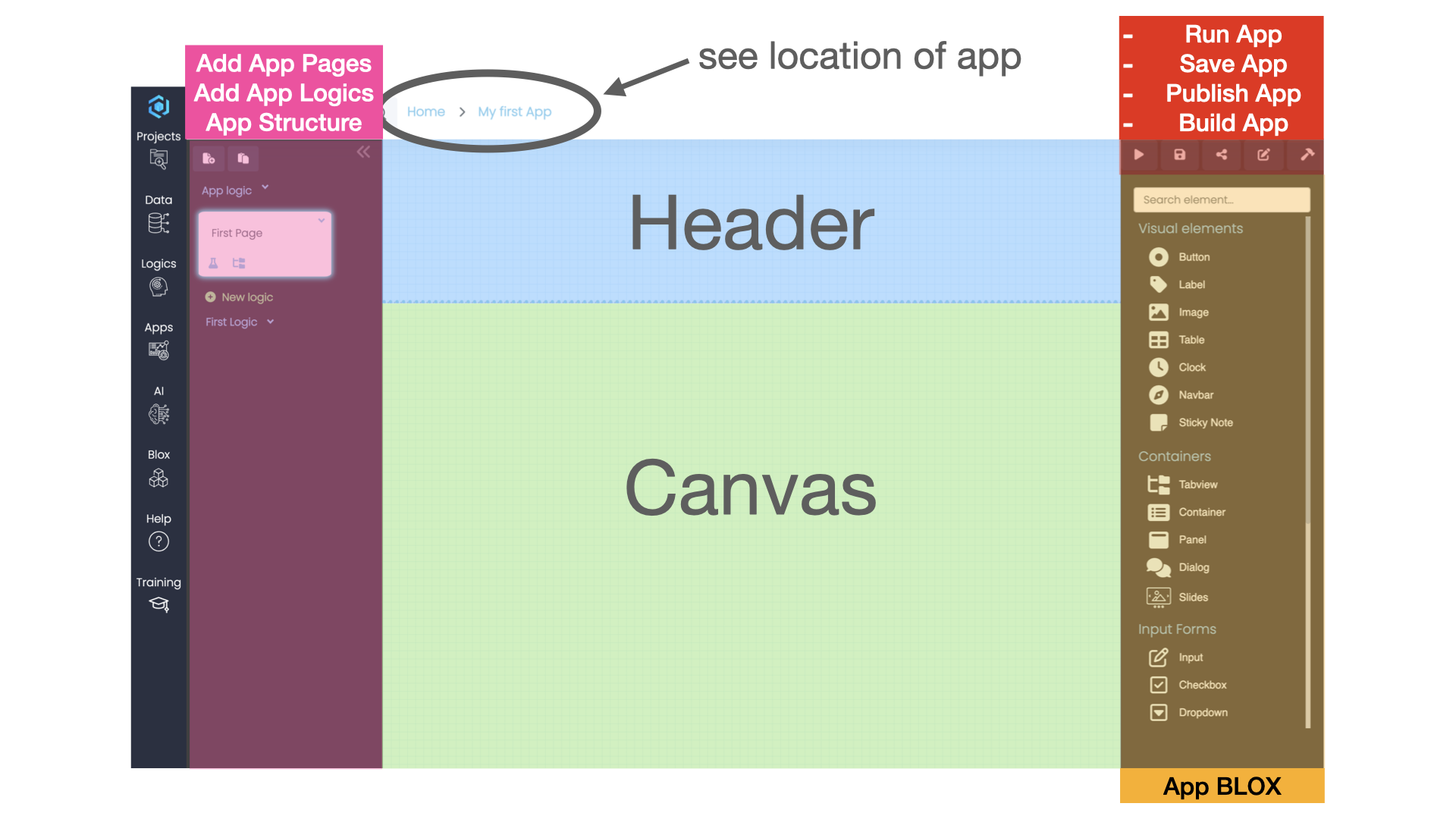
Structural Pages/Elements of an App
See yellow area
In the right panel, there are tabs to switch between the App Structure Panel and Add Element Template Panel.
- App Structure Panel: Navigate through app pages. Click the folder-tree icon to expand the element structure inside each page. Click the gear icon to edit the logic flows of the page.
- Add Element Template Panel: Contains Element Templates that can be arranged on the Page Canvas to create dynamic dashboards, web apps, business apps, user forms, and more.
Action Buttons in the App Designer
See red area
When opening an app for the first time, you'll enter Edit Mode. Click the Run button in the top right corner to execute the app and enter Run Mode, where you can preview what the app looks like to your customers or colleagues.
The action buttons allow you to:
- Run the app - Switch from Edit Mode to Run Mode
- Save the app - Save your latest changes
- Publish the app - Freeze the current state and share the app with your organization, colleagues, or customers. This allows you to revert to a previous version if needed.
- Configure the app - Set app resolutions, name, descriptions, and other settings
What are App Logic Flows?
The Flow Builder is accessible in the app designer as well. You can create logics that are executed when the app is running or using different app templates. For example a Button template could be used to trigger a complicated logic by connecting the Button template to the Start BLOX in the app logic. The output of this imaginary logic could in turn be connected to a Label template and populate content in the app. This is useful to create dynamic apps that react to user input.
What are App Pages?
Imagine you click a link on a webpage and are re-directed to a different page. An App Page is just a different page in your web app and can be accessed through actions defined by you (in the form of buttons) as well as logics.
What's the difference between the Canvas and the Header?
The difference between the header and the canvas is, that the header is accessible from multiple pages. Imaging you're building a multi-page web app or dynamic dashboard with additional actions/drill-down logics and you need a shared area between these pages such as a navigation bar, filter options, .... You could achieve this by using the header. Analogous to the header/footer in a word document, just next level.